
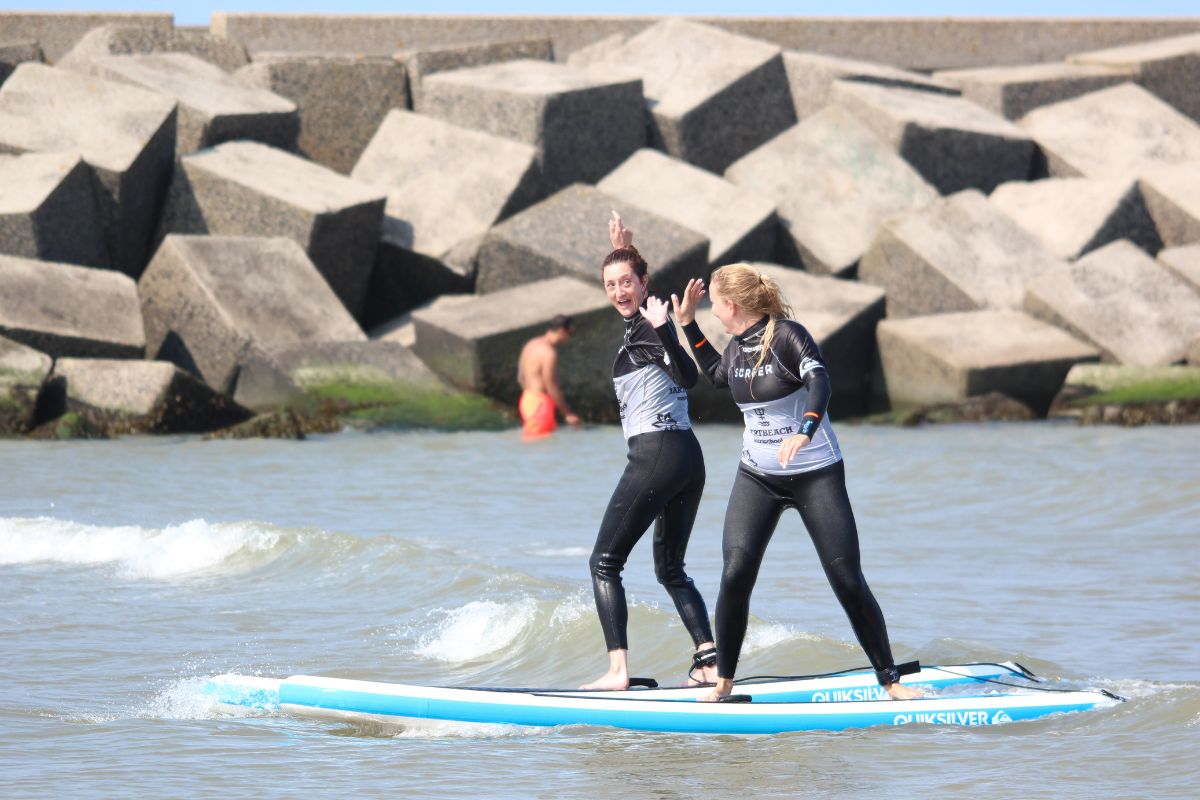
Below, I’ll explain how to turn your surfboard left and right when catching broken waves, as well as how to start surfing down the line. This is aimed at beginner surfers who are ready to move beyond just going straight and start learning how to turn their board.
Key takeways:
- Look where you wanna go: Your board tends to follow your eyes, so look up and towards the direction you want to turn instead of staring at your feet.
- Use your arms: Don’t let them dangle. Point your leading arm where you want to go and let your shoulders and upper body follow.
- Stay low and shift your weight: Keep your knees bent, stay relaxed and use your toes or heels to put pressure on the rail and turn the board.
- Don’t overthink it, just practise: Use a stable board, practise the movements on land or a surfskate, and don’t worry about looking “cool”. The more time you spend in the water, the more natural it becomes. Embrace the kook within you!
Turning your surfboard left or right: tips for beginners
Are you good with catching broken waves and standing up? Then the next step is to learn how to turn your surfboard left and right. Turning is mostly about looking where you want to go, using your upper body and shifting your weight.
This video below explains it pretty well for beginners:
Look where you wanna go
This is the #1 most important thing to remember: your board tends to follow your eyes.
If you want to turn your surfboard left, look left. If you want to turn right, look right. Turn your head first, and then your shoulders and upper body will naturally start to follow. Your hips, knees and board follow from there.
A common beginner mistake is looking at the nose of the board while trying to turn. Your body then has no clear direction to follow.
So look where you want to go.
Use your arms as your steering wheel
Another thing a lot of beginners do is let their arms dangle next to their body. It might feel uncool to lift your arms up and get into a proper surf stance, but this actually makes it much harder to balance and turn. Just like your eyes, your hands help determine where you’re going.
Keep your arms (and shoulders) relaxed rather than stiff, but don’t let them hang by your sides. When your hands are pointing down, your weight distribution can become uneven, which can also kill your speed.
Instead, use your arms to help guide your body and board. When you want to turn, point your leading arm in the direction you want to go.
Lean onto your toes or heels
Just like prone surfing, your board turns when you shift your weight onto one of its rails. To turn one way, you put more pressure through your toes; to turn your surfboard the other way, you put more pressure through your heels.
Keep your knees bent and make the movement fairly gentle at first. You don’t need to throw your whole body into the turn.
Turning frontside
When you’re surfing down the line (with your hips facing the wave), this is your frontside. To turn your surfboard frontside, look and point your leading arm to where you wanna go and shift your weight towards your toes.
Look in the same direction as your leading arm (or visa versa). When you initiate the turn, put your weight on your back foot and your toes. Your back foot helps you pivot the board.
Don’t keep your weight on your back foot for too long, as this will slow you down. Remember, the nose is the gas pedal and the tail is the brake. The more you’re on your tail, the more you slow down and the more likely you are to lose the wave.
Keep your knees bent and your hips and shoulders low. This lowers your centre of gravity, keeping you stable. As you look and reach towards where you want to go, your shoulders and hips rotate, your weight shifts onto the rail, and your board follows
Turning backside
When your back is facing the wave, you’re surfing backside. Again, start with your eyes. Look over the shoulder in the direction you want to turn, point your leading arm and let your shoulders follow.
This time, shift your weight towards your heels to put pressure on the back rail. Keep your knees bent and your body low rather than standing up straight.
Practise both ways
Don’t only practise turning in the direction that feels easiest. Spend some time going both left and right, especially if one side feels completely unnatural at first.
The more you practise, the easier turning both ways becomes.
5 common mistakes to avoid when learning to turn your surfboard
1. Looking down at your feet
This is super common when you’re learning. You want to check where your feet are on the board, make sure you’re standing in the right place and, before you know it, you’re staring straight down.
BUTTT if you’re looking at your feet, you’re not looking where you want to go, making it much harder to turn. Try to teach yourself to look up as quickly as possible after popping up.
2. Standing up too tall and stiff
Learning to surf can be stressful, and when you’re nervous, you tense up and stand like a plank. But the stiffer your body is, the harder it becomes to move, balance and turn.
Keep your knees bent and try to stay relaxed. And remember: it’s all about having fun! Don’t obsess over how quickly you’re progressing. The more time you spend in the water, the more natural everything starts to feel.
3. Not having the right board
Don’t let your ego choose your board. If your board is too small, everything becomes harder: catching waves, standing up, balancing and, yes, turning. There’s absolutely nothing wrong with starting on a bigger board or a foamie (soft top).
It makes learning so much more enjoyable when you have a stable surfboard underneath you.
4. Not practising on land
You don’t have to wait for your next surf session to practise turning. Try a surfskate, or simply practise the movements on the floor. Look in the direction you want to turn, point your leading arm, rotate your shoulders and shift your weight.
This way, you’re teaching your body and brain the movement, and it will become part of your muscle memory.
5. Trying to do it perfectly or “cool”
This is a big one. You think everyone is watching you. They’re not. And even if they are, who cares? You’re learning something new!
Trying to make every movement look perfect or “cool” just puts more pressure on yourself and makes you tense. So, just say fuck it, make a complete fool of yourself and USE YOUR ARMS. Don’t be afraid to look like a nerd or kook.
The surfers who geek out over technique, practise weird movements on land and aren’t afraid to look ridiculous are the ones who end up surfing really well.
Embrace the kook within you. 🤙
Want more tips? Here are 7 tips for beginner surfers (for all ages).
Let’s surf together!
Looking for other surfers to surf with? Wildheart Surf organises regular surf meet-ups in Domburg (Zeeland, Holland) for surfers of all levels. Come for a surf, meet some new people and share the stoke.
Want to join the next one? Get in touch with us or check out @wildheartsurf on Instagram for upcoming meet-ups and events.
Written by

Hi, I’m Jess, founder of Wildheart Surf. I’ve been surfing for nearly two decades and teaching since 2014 (as a certified ISA Level 1 Surf Instructor and Yoga Teacher). I love sharing what I’ve learned from years of surfing, travelling and exploring the outdoors. Through Wildheart Surf, I want to bring people together and empower women to find their own adventure and joy.